
Whither micropaleontology? Advances in AI for microfossil identification and information search.
AUTHORS
Maria Antonieta Lorente
Universidad Central de Venezuela, Facultad Ingeniería, Escuela de Geología, Minas y Geofísica.
Ellington Geological Services LLC, Houston, Texas, US
lorente.maria.antonieta@gmail.com
Abstract
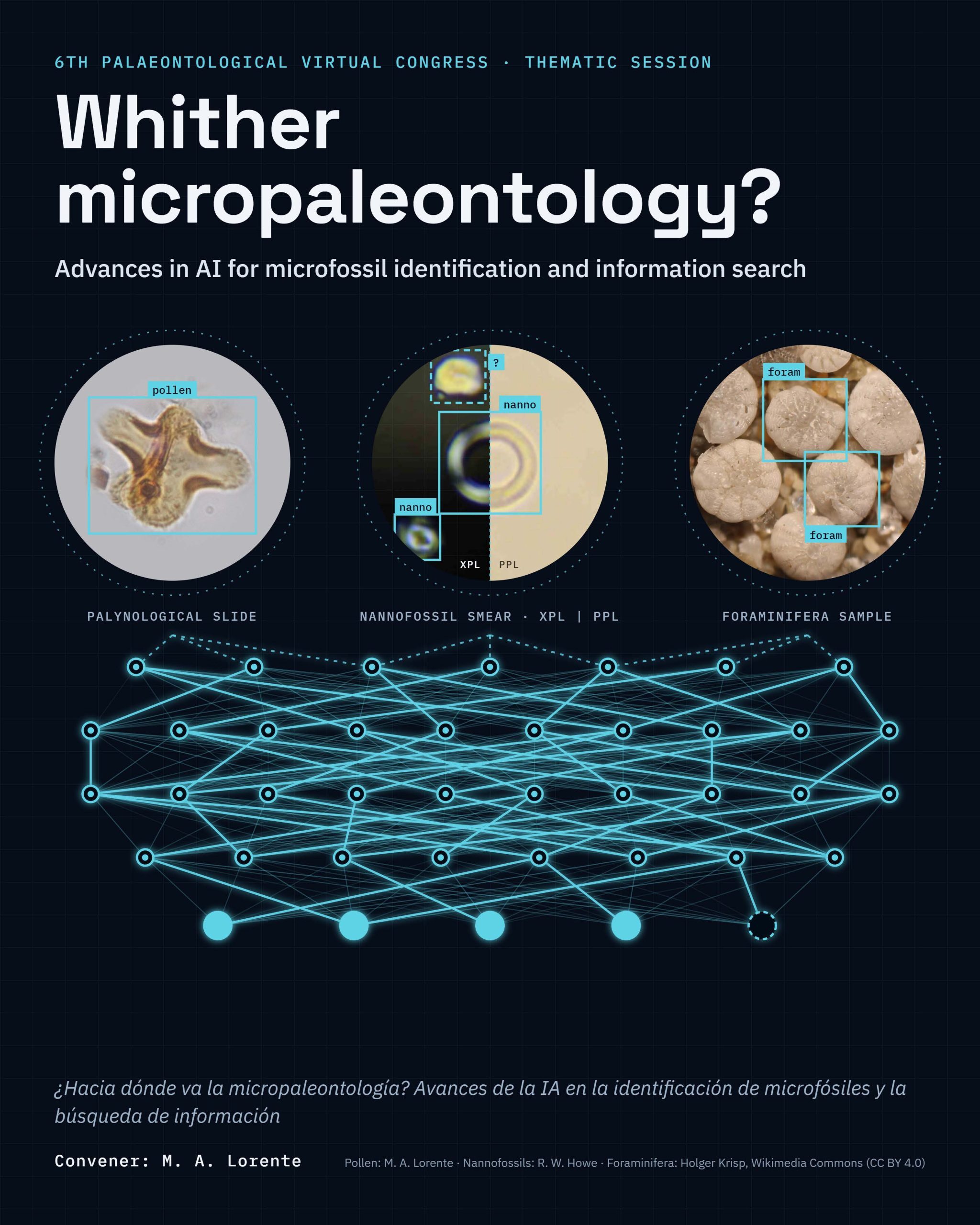
Microfossils underpin biostratigraphy and the reconstruction of past environments and climates. These include foraminifera, calcareous nannofossils, radiolarians, diatoms, ostracods, pollen, spores and dinoflagellate cysts. Yet their identification still depends on the trained eye of a shrinking community of specialists. Teaching computers to recognise microfossils is not new. Expert systems and digital image analysis were already being developed in academia and industry in the late 1980s and 1990s. What is new is the pace.
Deep-learning models now detect and classify microfossils on whole digitized slides in hours rather than days. Large, well-curated digital reference collections are becoming the foundation for training these models. Large language models and AI “librarian” agents are beginning to change how we search, synthesise and compare the taxonomic and stratigraphic literature. Building on the palynology session at the 5th Palaeontological Virtual Congress, this session asks where micropaleontology is heading. We welcome contributions on: • automated detection and identification of any microfossil group • image acquisition and slide digitization • curation of collections and image libraries • AI-assisted taxonomy and information retrieval • validation of AI results against expert analysis • applications in research and industry • historical perspectives on early computer-assisted systems The session especially encourages work that examines the limits of these tools. Identification is only the first step: interpretation remains in the hands of the specialist.